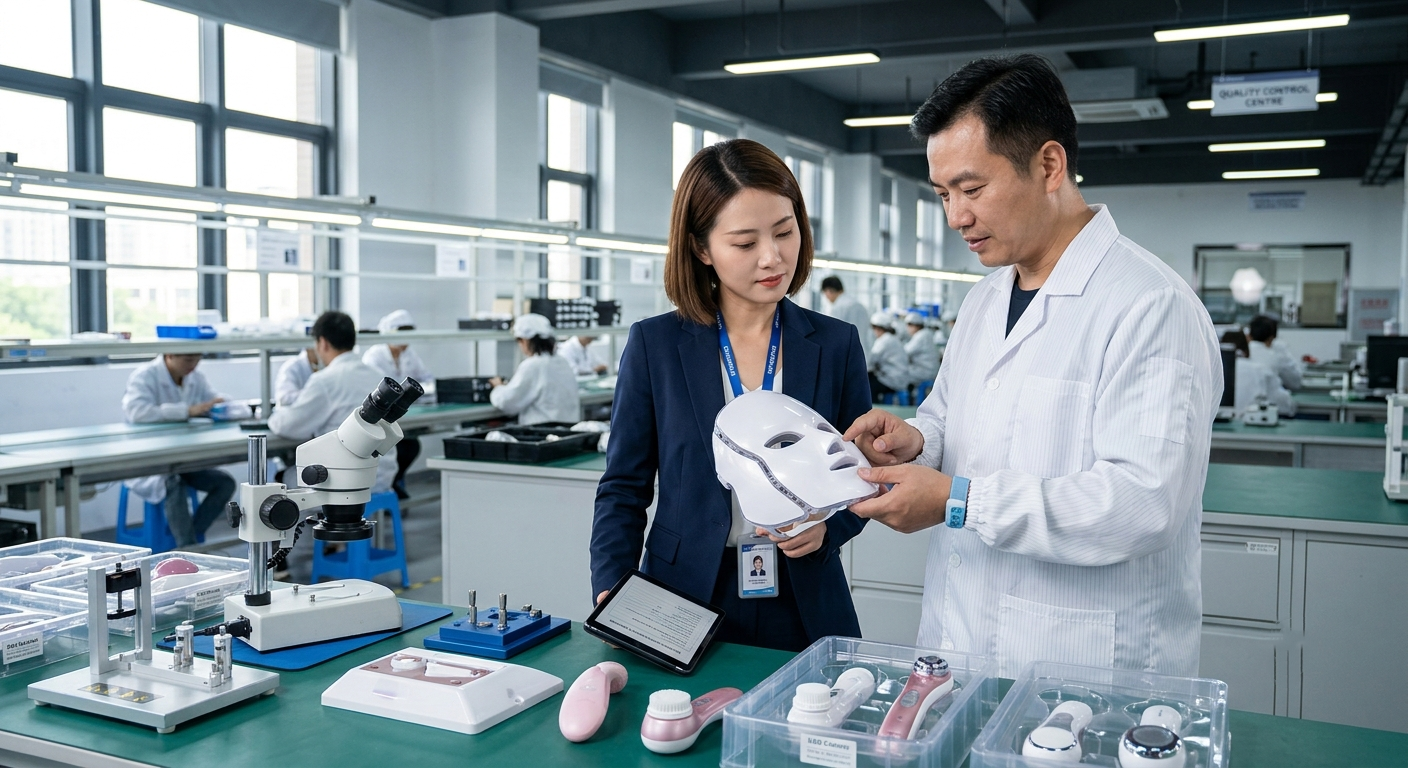
My 15 Years in Beauty Device Exporting: The Supply Chain Problems I’ve Seen
My 15 Years in Beauty Device Exporting: The Supply Chain Problems I’ve Seen
When I first started in the beauty device export industry over 15 years ago, the landscape was completely different. Back then, "home beauty tech" was a niche concept. Today, from advanced LED therapy masks to high-frequency facial wands, smart skincare devices are a global boom.
But as the market grew, so did the chaos in the supply chain.
Over the past decade and a half, I have personally guided dozens of international brands, Amazon sellers, and beauty distributors through the complex waters of Chinese manufacturing. I have also watched many well-meaning buyers hit sudden brick walls. I’ve seen custom shipments seized because of missing certificates, product listings permanently deleted overnight due to QC failures, and brands nearly ruined by rigid suppliers who refused to cooperate on small test batches.
That is exactly why I established Xiamen Lucky Lion Technology in Xiamen, China. I didn’t want to run just another blind trading agency or a rigid factory that only cares about massive order volumes. I wanted to build a business that acts as your eyes, ears, and quality control team on the ground.
Because I have managed this entire lifecycle for over a decade, I can anticipate exactly what will go wrong at every single stage of the process. My value isn't just in finding products—it is in my ability to proactively maximize your protection and shield your business from these hidden dangers before they ever happen.
If you are sourcing beauty devices from China, you must interested to know more about these hidden traps, did you meet the same before?
The Overwhelming Sea of Choices—Wasting Time and Money
For most international buyers, heading to major B2B platforms like Alibaba feels like the logical first step. But let’s be honest: browsing those massive directories is exhausting. You are faced with a sea of identical product photos and thousands of vendors all using the exact same script: "We are the original source factory."
It’s incredibly easy to get trapped in endless message threads, chasing that rock-bottom quote. But in this industry, a suspiciously cheap price tag always comes with a hidden compromise in quality, reliability, or honesty.
A Real Story from My Caree
A while back, a buyer came to us to source an LED eye care wand. We handled his first order, and everything went incredibly smoothly—the quality was spot-on. But when it came time to reorder, he hesitated. He felt our price wasn’t "cheap" enough.
Because his order volume was on the smaller side, it was a low-MOQ custom order, which incurred a standard $100 customization fee to cover custom manuals and logo printing. We had priced everything as tightly and fairly as possible for that premium quality, but that extra $100 bugged him. Hoping to save a quick buck, he bought into the empty promises of another online supplier who offered a dirt-cheap quote with zero extra fees. He moved his business to them.
Fast forward a few months. It was barely 20 days before the Chinese New Year (CNY) holiday—the most chaotic, high-stakes shipping window of the entire year. I woke up one morning to a massive wall of text from him on WhatsApp. He was in a complete panic.
"I messed up," he told me. "Please help."
He had just received the first 100-piece trial batch from the cheaper supplier. The quality was absolute garbage—total junk, and completely different from the standard we had set. To make matters worse, because he was desperately trying to get the rest of his inventory out before China completely shut down for the holidays, he had already wired the advance deposit for his main production run to this new vendor.
He came back to us showing deep regret. It is a brutal reality in China: products often look identical in photos, but everything else—the packaging, the accessories, the cord quality, the manual size, the colors—tells a completely different story.
But the timing was brutal. If you know anything about Chinese manufacturing, trying to pull off a miracle two weeks before CNY is nearly impossible. Logistics are freezing up, and workers are already heading home. Our own raw materials were almost cleared out, and any new custom production would have to wait until after the holidays.
We pulled out all the stops and scrambled to redo the order for him as fast as humanly possible. But because he tried to save that $100 on a sketchy gamble, the delay cost him his entire peak sales season. He lost thousands in missed revenue just to save a hundred bucks.
You might also think that trading through a third-party platform means your money is completely safe. But the truth is, countless cautious buyers still get scammed out of their funds. They wire the money, and the supplier simply never ships the goods. Sometimes, even if a company looks verified and registered on the platform, it turns out to be a complete ghost setup designed solely to steal your cash. You end up burning massive amounts of time and money with zero protection. The platform itself might be trustworthy, but that doesn't mean every single vendor on it is.---
The Communication Nightmare—Rigid Systems, Arrogant Factories, and Hidden Risks
Dealing directly with a Chinese factory can be a major headache. With thousands of manufacturers out there, your success doesn't just depend on their machinery—it depends entirely on their attitude and who is handling your account.
Too often, factory sales reps don't understand international brand standards. High staff turnover means your project constantly gets passed around, forcing you to restart technical conversations from scratch. If you have a unique customization or a smaller order, many rigid, traditional factories simply won't waste their time pushing it through their bureaucratic system.
It gets even worse if you find a killer beauty device that only one factory makes it. Because they hold a monopoly, they become incredibly arrogant. Even if you meet their standard MOQ, they treat you like you're completely replaceable. They ignore your specifications, drag their feet on production, and straight-up ghost you when it comes to after-sales support.
When a supplier has that "take it or leave it" attitude, communication completely breaks down.
Worse, they bury hidden risks that you won't even spot until the cargo lands on your doorstep. Because they completely skip rigorous quality control, you end up with defective items or typos on the retail packaging. Even the logo print—which looked flawless on the approved golden sample—can end up completely deformed or printed in the wrong font across the entire mass production batch.
By the time you realize what happened, the headaches aren't worth it, and you're forced to kill the product line entirely. An uncooperative factory will kill a great product every single time.
Rigid MOQs That Kill Growing Brands Before They Start
Traditional big factories love to throw astronomical minimum order quantities (MOQs) at you right out of the gate. Look, if you’re a startup or an e-commerce brand just trying to test the waters with cheap, low-ticket items like a silicone body scrubber or a basic manual scalp massager, the risk is low, and you can probably stomach the upfront cost.
But when it comes to high-ticket electronic beauty devices, committing to 500 or thousands of units on your very first order isn't a calculated business move—it’s a straight-up gamble. It suffocates your cash flow overnight and carries a level of financial risk that will keep you up at night.
The cold truth is that these massive manufacturers don't care about "growing with your brand." To them, a small order isn't even worth turning the machines on for. Without a savvy local partner on the ground who has the leverage and relationships to negotiate on your behalf, you will never get flexible, tiered ordering. They simply won’t give you the option to test a small batch first and scale up once you start making sales.
Unexpected Reality of Factory Quality Control
In manufacturing, there is one universal truth: A perfect sample does not guarantee a perfect mass production run.
I’ve seen factories rush production to hit a tight shipping deadline, and the results are always a mess. We’re talking cosmetic scratches on the casing, dust trapped inside sealed retail boxes, and greasy fingerprints all over sensitive electronic beauty tools.
If you don’t have an independent, strict agent on the ground to push the process, check the quality, and flag minor detail issues before that cargo leaves the port, relying solely on the factory’s internal QC is a massive gamble. Honestly, some factory workers don't even comprehend what "high-end international standards" actually mean.
For an e-commerce seller or a growing brand, this kind of sloppy work is the ultimate nightmare. Your cargo spends a month at sea, and by the time you realize there's a problem, the negative reviews are already rolling in. In this game, a handful of angry customers and 1-star reviews can permanently destroy a product listing you spent years building.
Logistic Chaos—The Last Mile Where You Cannot Relax
While production delays are highly frustrating, careless handling of the logistics phase can be financially devastating. Think of manufacturing like a football match: you’ve spent months getting everything right on the field, but logistics is that final shot on goal. If you mess up the kick, the entire game is lost.
When it comes to this final stretch, some frequent problems happens:
- Document Errors: Factories failing to verify the HS Codes and Product Descriptions on the Bill of Lading (B/L) with the buyer before exporting. Combine that with a vague, poorly detailed Packing List, and you have a recipe for instant customs audits, massive demurrage (port storage) fees, and heavy penalty fines.
- Undeclared Sensitive Cargo: This is a massive trap when shipping beauty devices via express couriers (like DHL, FedEx, or UPS). Because many modern beauty devices feature built-in lithium batteries, or ship with accompanying gels/liquids, they are classed as "sensitive goods." Unprofessional factories often try to fly under the radar and ship these without proper hazardous materials declarations or the necessary MSDS/UN38.3 certificates.
The result? The shipment gets flagged at airport security, customs rejects the package, and the buyer is hit with unexpected freight surcharges or a total Return to Sender (RTS)—leaving you with double the shipping bill and zero inventory.
The Ultimate Truth: Finding a Reliable Partner in Beauty Device Sourcing
Over my 15 years in this game, I’ve learned one fundamental truth: A highly responsible partner on the ground is worth a million times more than just a good product.
Yes, there are plenty of chaotic, uncooperative factories out there. But through a decade and a half of trial, error, and heavy filtering, we’ve found the hidden gems. We’ve built tight, rock-solid partnerships with top-tier manufacturers who actually have flawless management systems, smooth workflows, and deeply accountable teams. When you team up with the right people, sourcing flips from a chaotic nightmare into a seamless, stress-free, and profitable engine.
Because we’ve already spent 15 years separating the best from the worst, we bring that exclusive, vetted network straight to your brand. We don’t just "find products"—we act as your eyes and ears on the factory floor, handling everything from complex OEM/ODM customizations to making sure that final, crucial shot on goal—your logistics and paperwork—is absolutely bulletproof.
Whether you’re a seasoned distributor or a fast-growing e-commerce brand, you don’t have to navigate the chaos of China's supply chain alone. Let my 15 years of hard-earned experience work for you.
Let’s stop gambling on supply chains, and start building something solid.